This is a div block with a Webflow interaction that will be triggered when the heading is in the view.

Introduction: Beyond the Two-Minute Feature
Last week, our product manager shipped a feature in two minutes using AI. It was a simple modification—changing how our API structures certain JSON outputs for a specific customer use case. Normally, this would've gone through the standard process: product backlog, sprint planning, development, QA, deployment. A month, minimum. Sometimes these "small" requests sit in the backlog for six months or get deprioritized indefinitely.
But he just described what he wanted to Cursor AI, and it was done. Deployed. Working.
He's not a developer. He's never written production code. He just understood the requirement clearly.
That moment was interesting, but not revolutionary. What kept me up that night was a different realization: he could have built something far more complex.
Not just changing JSON output. He could have:
- Built a complete integration with our customer's SIEM platform
- Created a custom workflow automation across multiple tools
- Redesigned an entire section of the UI for a specific use case
- Implemented complex business logic for threat correlation
The AI didn't care about complexity. It just needed clear requirements.
This wasn't a glimpse of better feature development. It was a glimpse of a completely different paradigm.
Part I: The Manifesto
Thesis: Software development is about to undergo its third great democratization.
First wave (1990s-2000s): Open Source
Developers could read, modify, and contribute code to any project. Linux proved that distributed collaboration could build enterprise-grade software. GitHub made it trivial to fork, modify, and contribute back.
Impact: Democratized software creation among developers.
Second wave (2010s): Cloud & APIs
Developers could deploy infrastructure and integrate systems without specialized expertise. AWS meant you didn't need a data center. Stripe meant you didn't need to become a payments expert. Twilio meant you didn't need telecom knowledge.
Impact: Democratized deployment and integration among developers.
Third wave (2025+): AI-Native Software
Anyone who understands a problem can build substantial solutions. Not configurations. Not low-code drag-and-drop. Actual features with:
- Deep integrations connecting multiple systems
- Complex business logic encoding domain expertise
- Custom interfaces designed for specific workflows
- Multi-step automation orchestrating across platforms
Impact: Democratizes software creation beyond developers.
The Brutal Truth We Don't Talk About
Every B2B SaaS company is built on a lie: "We can be everything to everyone."
You can't. Your engineering team will never build:
- The 47 different SIEM integrations your customers use
- The industry-specific compliance rules for healthcare vs. finance vs. government
- The custom dashboards for every executive's preferred KPIs
- The workflow automations that mirror each company's unique processes
You have two options:
- Build a rigid product → Lose deals to "doesn't fit our needs"
- Build an infinitely flexible product → Drown in technical debt and complexity
Every product team lives in this tension. You prioritize. You say no. You build what serves the majority.
And you lose deals. You churn customers. You hear "if only it did X" over and over.
There's never been a third option. Until now.
Part II: The Vision - What Customers Will Actually Build
1. The Deep Integration
Background: Your customer uses Splunk, Azure Sentinel, and a proprietary internal tool for threat intelligence. They need all three connected to your platform in a specific way that only makes sense for their organization.
Traditional Approach
Customer: "Can you integrate with our systems?"
You: "Splunk is on the roadmap for Q3. Azure Sentinel maybe Q4. The proprietary tool... we'd need to evaluate if there's enough demand. Probably a custom development engagement—$200K, six months."
Result: Lost deal, or years of waiting, or expensive custom development
AI-Native Approach
Maria, a security operations manager with zero programming background, opens Development Mode in your product and describes what she needs in plain language.
Time: 10 minutes
Cost: $0 in custom development
Engineering team: Not involved
The AI agent analyzes the three API specifications, generates integration code with proper error handling, creates correlation logic, builds scheduling, implements secure credential management, runs security scans, performance tests, and deploys to her organization's isolated branch.
2. The Complex Business Logic
Background: A financial services customer needs risk scoring that incorporates your threat intelligence plus their proprietary client data, regulatory requirements, and risk appetite—logic that only they understand because it's based on years of institutional knowledge.
James, a risk manager who understands their business but has never coded, describes the complete algorithm including regulatory tier adjustments, temporal decay, geographic risk factors, and executive dashboards.
This isn't configuration. This is building a sophisticated product feature that encodes years of institutional knowledge.
And because James described it, it's exactly what they need. No lost-in-translation between business and engineering.
3. The Custom Interface
Background: Your SOC analysts need a completely different view than your executives, who need a different view than your compliance auditors. Your product has one interface designed for a general user. It serves no one perfectly.
The customer describes three complete, purpose-built interfaces:
- For SOC Analysts: Real-time threat monitoring with keyboard shortcuts, dark mode, sound alerts, PagerDuty integration
- For Security Leadership: Executive dashboard with board-ready design, PowerPoint export, industry benchmarks
- For Compliance Auditors: Complete audit trail, evidence collection, regulatory framework mapping, tamper-evident records
Each interface is purpose-built for its users. Not a compromise. Not "close enough." Exactly right.
4. The Workflow Automation
Background: When a critical threat is detected, the customer needs a complex, 15-step response workflow across 7 different systems. This workflow represents years of incident response refinement and is specific to their organization.
The security team describes their complete incident response workflow including:
- Immediate actions (Jira tickets, Slack alerts, user queries)
- Containment actions (AD account disabling, password resets, session revocation)
- Intelligence gathering (historical incidents, SIEM correlation)
- Escalation logic (PII breach protocols, legal notifications)
- Monitoring and reporting (dashboards, evidence collection, audit trails)
This is enterprise-grade automation built by the people who designed the process and understand every nuance.
The security team knows their process. Now they can build their process.
Part III: Addressing the (Much Bigger) Critics
"You're insane. This is a security apocalypse."
Let's be very clear about what makes this not insane:
1. Sandboxed Execution Environments
Customer code doesn't run in your core infrastructure. It runs in isolated containers with resource limits, network isolation, data isolation, code isolation, and time limits.
2. AI-Powered Security Scanning
Every line of generated code goes through multiple security layers:
- Static Analysis: SQL injection, XSS, credential exposure, dangerous functions
- Dynamic Analysis: Runtime behavior, network activity, resource usage
- Dependency Scanning: Known vulnerabilities, license compliance, supply chain
- Compliance Checking: GDPR, SOC 2, HIPAA, PCI-DSS
3. Permission Boundaries (The Real Key)
Customers can't do anything. They can only work within strictly defined boundaries. A customer building a Splunk integration can call their own Splunk instance and read their own threat data, but cannot access another customer's data, modify core algorithms, bypass authentication, or access your infrastructure.
4. Automated Testing Gauntlet
If any test fails, code doesn't deploy. Period.
5. Human-in-the-Loop for High-Risk Changes
For potentially dangerous operations (database schema modifications, privilege elevation, external network connections), humans must approve.
6. Instant Rollback & Canary Deployments
One-click rollback, automated rollback on error rate thresholds, canary deployments with gradual rollout.
Part IV: Technical Architecture
Here's how the system works:
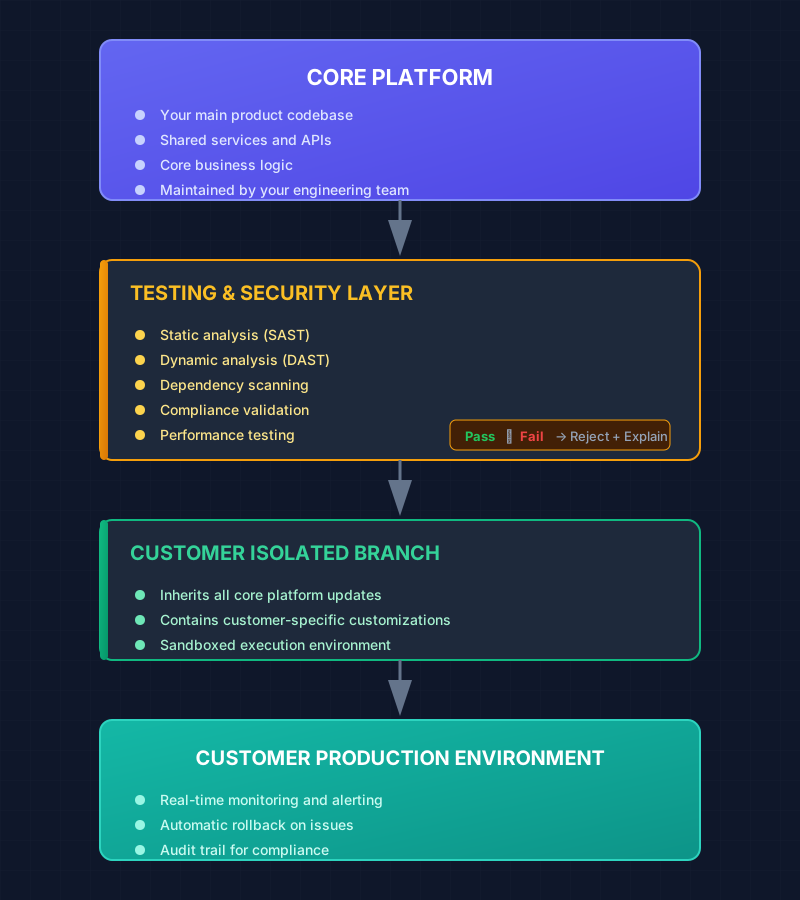
Key principles:
- Defense in depth: Multiple security layers, not just one
- Fail safe: If anything is uncertain, reject and explain
- Isolation: Customer code can't affect other customers
- Observability: Everything is logged and monitored
- Reversibility: Easy to rollback if something breaks
Part V: The Business Model Revolution
1. Infinite Scalability Without Linear Headcount Growth
Traditional SaaS: Revenue scales with headcount (bad economics)
AI-Native SaaS: Revenue scales independent of headcount (great economics)
You become more like AWS (platform) than Salesforce (application).
2. Network Effects That Compound
More customers = more integrations built = more valuable to next customer. Customer features become your R&D lab.
3. Competitive Moat That Deepens Over Time
Competitor can't copy what customers built. Switching costs include losing all customizations. The lock-in is natural, not artificial.
4. New Revenue Streams
- Direct: Development Mode licensing, AI compute fees, premium features
- Marketplace: Transaction fees (15-30%), certification fees, premium placement
- Services: Consulting, migration, custom model fine-tuning
New Pricing Model
- Standard ($X/month): Use product as-is, core features
- Professional ($3X/month): Request features, priority support
- Enterprise ($10X/month): Full Development Mode, build integrations and workflows
- Enterprise Plus ($20X/month): Unlimited AI compute, white-glove assistance
You're not selling software. You're selling a platform for their success.
Part VI: The Roadmap - What Happens When
Phase 1: 2025-2027 - The Foundation
What's technically possible:
- Simple integrations (webhooks, API calls, basic connectors)
- Basic workflow automation (if-this-then-that logic)
- UI theming and customization
- Report and dashboard modifications
Key milestone: First 100 customers successfully deploy custom integrations without engineering support.
Phase 2: 2027-2030 - The Expansion
What's technically possible:
- Complex multi-system integrations (5-10 tools)
- Sophisticated business logic and algorithms
- Complete UI redesigns
- Machine learning model customization
Key milestone: First customer-built feature generates $1M+ in marketplace revenue.
Phase 3: 2030-2035 - The New Normal
What's technically possible:
- Customers build substantial product extensions
- AI agents autonomously suggest and build improvements
- Real-time feature deployment (describe → deployed in seconds)
- Customer-to-customer feature marketplace with thousands of offerings
Key milestone: Customer-generated features exceed vendor-generated features in the product.
Part VII: Why This Matters Beyond SaaS
1. Power Dynamics in B2B Relationships
Current: Vendor controls roadmap, customer submits requests and hopes
Future: Customer controls their own experience, vendor provides platform and capabilities
2. Speed of Innovation
Current: Features take months or years, great ideas die in backlogs
Future: Innovation happens at market speed, not engineering speed
3. Economic Model of Software
Current: Labor-intensive, revenue tied to developer headcount
Future: Capital-intensive (AI compute), not labor-intensive
4. The Definition of "Product"
Current: Product = fixed set of features
Future: Product = platform + capabilities. "SaaS" becomes "Software as a Service AND Studio."
5. Labor Market Evolution
Jobs that decrease: Implementation consultants, integration engineers, custom development teams
Jobs that increase: Platform architects, AI prompt engineers, security specialists, feature curators
Part VIII: What Could Go Wrong
Risk 1: Technical Debt Explosion
Nightmare scenario: 250,000 custom features might break with a major architectural change.
Mitigation: Automated refactoring tools, deprecation schedules, API versioning, financial incentives for updates.
Honest assessment: This will be painful. The question is whether automation can manage it.
Risk 2: Security Breach from Customer Code
Nightmare scenario: AI misses SQL injection vulnerability, breach spreads to other customers.
Mitigation: Defense in depth, strict isolation, cyber insurance, bug bounty programs.
Honest assessment: Breaches will happen. The question is whether damage can be contained.
Risk 3: AI Hallucinations Create Broken Features
Nightmare scenario: Subtle logic bug manifests during high-stakes moment.
Mitigation: Extensive testing, canary deployments, easy rollback, AI confidence scoring.
Honest assessment: Bugs will happen. AI isn't perfect.
Risk 4: Regulatory Nightmare
Nightmare scenario: Customer builds feature that violates regulation without realizing.
Mitigation: Industry-specific compliance checking, regulatory engagement, insurance products.
Honest assessment: Regulations lag technology. Early movers take risk.
Risk 5: Platform Becomes Too Complex
Nightmare scenario: So many guardrails that Development Mode becomes unusable.
Mitigation: Simplicity as core design principle, progressive disclosure, continuous UX improvement.
Honest assessment: Finding the balance between "safe" and "usable" will be the hardest part.
Conclusion: The Inevitable Future
In 10 years, we'll look back at 2024's SaaS model the way we look at shrink-wrapped software in 2000.
"Wait, customers had to ask permission to add features? They couldn't just build what they needed?"
It will seem absurd that we operated this way.
The Technology Trajectory is Clear
- AI code generation: 80% there
- Security validation: 50% there
- Testing automation: 70% there
- Branch management at scale: 40% there
- Business model clarity: 60% there
We're at 60% of the way there today. The gaps are closing fast.
The Companies That Win
The winners won't be: The ones with the most features (everyone will have infinite features)
The winners will be: The ones with the most robust platforms, strongest guardrails, richest ecosystems, best AI code generation, and most trust.
Competition shifts from "what features do you have" to "what can I build on your platform."
What You Should Do Now
If you're a founder or CTO:
- Identify one low-risk area where customers could build safely
- Build the guardrails first before opening any customization
- Start small with trusted customers in beta
- Invest in platform thinking even if you're years away from this
If you're a product manager:
- Audit your backlog—what could customers build themselves?
- Talk to customers about what they'd build if they could
- Think platforms, not products
If you're an engineer:
- Learn about AI code generation—it's your future toolkit
- Focus on architecture—platform-building skills will be in high demand
- Security and testing become even more critical
- Don't fear this—it elevates your work, doesn't replace it
If you're a customer:
Ask your vendors: "Can I build custom integrations? Do you have an API I can extend? Can I customize workflows for my specific needs?"
Vote with your wallet. Vendors that enable you will win.
The Final Question
I started this article with a story about a two-minute feature change. But that was thinking too small.
The real question is: What will your customers build when you give them the tools?
Integrations you never imagined? Workflows you didn't know existed? Interfaces designed for use cases you never considered? Business logic that encodes decades of industry expertise?
The answer is: things that will make your product 10x more valuable.
You just have to be brave enough to let them.
This future is coming. Not in 2026. But it's coming.
The companies that figure this out first won't just have a competitive advantage. They'll be competing in a different game entirely.
What do you think?
Where am I wrong?
What technical challenges am I underestimating?
What opportunities am I missing?
What would you build if your vendors gave you Development Mode tomorrow?